REACH Compliance Certification (Global)
REACH registration and compliance support for Indian exporters of chemicals and chemical-containing products selling into the EU.
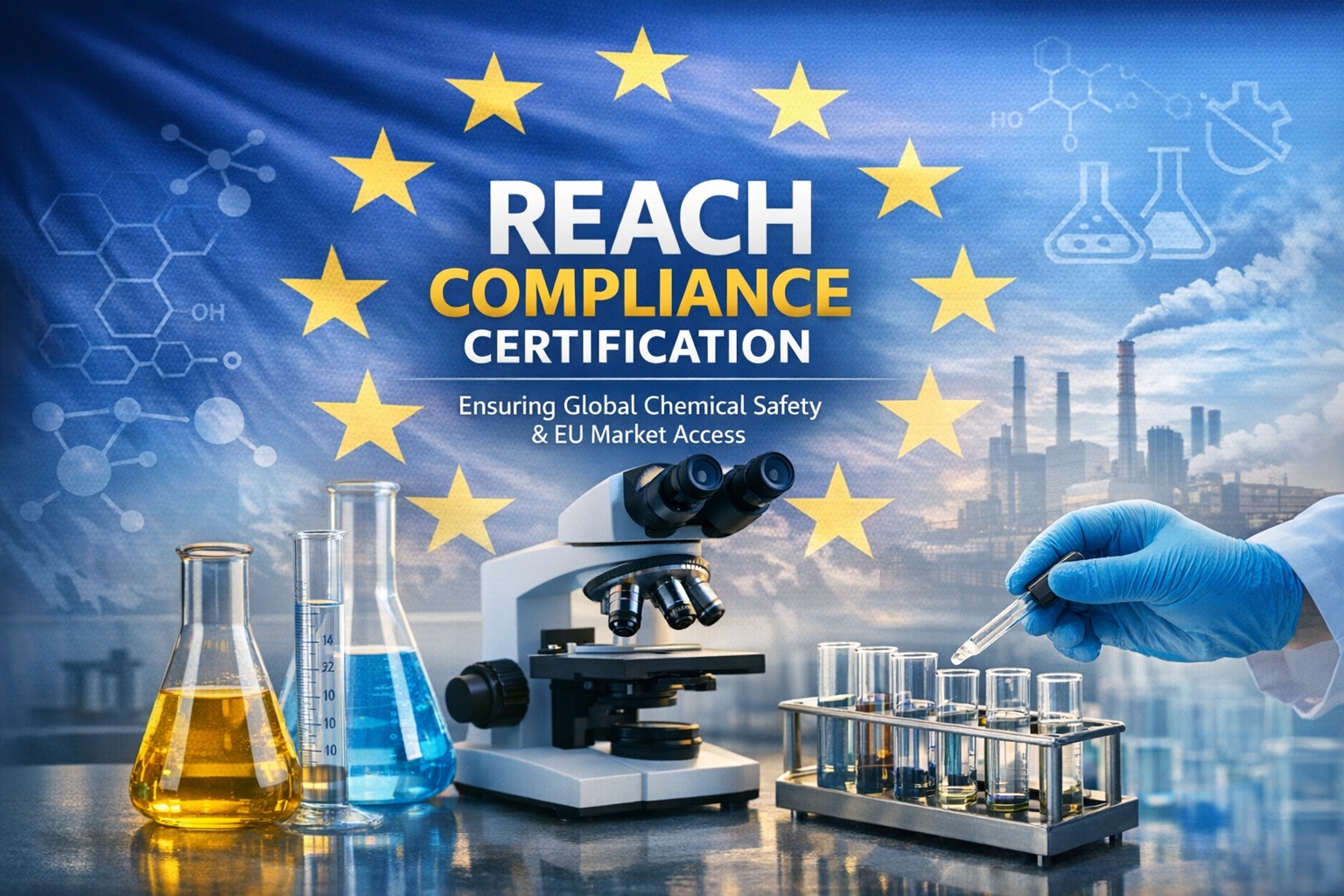
REACH is the European Union's chemical safety regulation (Regulation EC 1907/2006). If you make, import or sell chemical substances into the EU, you generally have to register them with the European Chemicals Agency (ECHA) before the material can legally be placed on the market. One thing worth clearing up early: there is no "REACH certificate" handed out at the end. What you get is a registration number, and what you carry afterwards is a set of ongoing duties.
For Indian exporters this is where things usually go wrong. A non-EU manufacturer cannot register directly with ECHA. The registration has to come either from the EU importer or from an Only Representative (OR) appointed by you, and who does what changes your costs, your data exposure and your customer relationships.
Who Needs to Comply with REACH
- Indian manufacturers exporting chemicals to the EU, whether as pure substances or inside mixtures.
- EU importers and distributors buying from India, who often ask their Indian supplier for REACH documents before placing an order.
- Exporters of finished articles (textiles, plastics, electronics, leather goods) where the article contains restricted or high-concern substances above set limits.
The main trigger for registration is volume: a substance manufactured or imported into the EU at one tonne or more per year per legal entity. Below that, registration is not required, but supplier communication and restriction rules can still apply.
Is Your Product Covered? How We Check
Before anything else we sort your portfolio into three buckets, because each one has different obligations.
- Substances on their own or in mixtures at one tonne or more a year need registration.
- Articles (finished goods) usually do not need registration, but if they contain a Substance of Very High Concern (SVHC) above 0.1% by weight, there are notification and customer-communication duties.
- Restricted substances listed in Annex XVII of REACH are limited or banned in certain uses, regardless of tonnage.
REACH Compliance Process, Step by Step
1. Substance inventory
We list every substance you sell to Europe with its CAS/EC number, composition and the annual tonnage that actually reaches the EU, not your total production.
2. Work out your role
Manufacturer, importer, downstream user or article producer. The label changes what you must do, and many exporters assume the wrong one.
3. Decide the registration route
Either your EU customer registers as importer, or you appoint an Only Representative in the EU who registers on your behalf and keeps your customers' identities confidential. We help you compare both options before you commit.
4. Join the existing registration where possible
If the substance is already registered by others, you generally join that registration through data sharing and a Letter of Access, rather than redoing studies. This is often the biggest cost saver in the whole process.
5. Safety data sheet and exposure information
We prepare or review the SDS in the REACH format, including exposure scenarios for higher tonnage bands. Many Indian SDS files are written for the domestic market and get rejected by EU buyers.
6. Technical dossier
The registration dossier is built in IUCLID with the substance identity, hazard data and, for 10 tonnes and above, a Chemical Safety Report.
7. Submission through REACH-IT
The registrant submits the dossier to ECHA and pays the registration fee, which depends on tonnage band and company size.
8. Completeness check and registration number
ECHA checks the dossier for completeness. If anything is missing you get a deadline to fix it. Once it passes, you receive a registration number.
9. Keep it current
Tonnage changes, new hazard data and updates to the SVHC Candidate List all have to be reflected. Registration is not a one-off task.
Documents and Information Needed
- Substance identity including CAS and EC numbers, purity and impurity profile.
- Safety data sheet in the current REACH Annex II format.
- Tonnage data for what is sold into the EU, by year.
- Existing test reports on physical-chemical, toxicological and environmental properties.
- Use information for each application, so exposure scenarios can be written.
- Supply chain details, meaning who the EU importer or distributor is and what they need from you.
Only Representative or Customer Registration?
If your EU importer registers, they hold the dossier and you depend on them for access. If you appoint an Only Representative, you keep ownership of the registration and your customer list stays private, which matters when you sell to more than one EU buyer. The trade-off is that the OR takes on legal responsibility and charges for it. There is no universal right answer, and we usually walk exporters through both with their actual tonnage.
How Long Does REACH Registration Take?
For a substance that is already registered by others and where you only need to join, a few weeks to a couple of months is realistic. A new registration that needs fresh studies and a Chemical Safety Report can run to many months, because the testing and data-sharing negotiations are the slow parts, not the submission itself. We would rather give you an honest range after looking at your substance than quote a number up front.
What Affects the Cost
The ECHA fee depends on tonnage band and company size category. Beyond that, the real swing factors are the cost of the Letter of Access (or fresh studies if none exist), the Only Representative's fee, and how much SDS and dossier work is needed. Small exporters in the one to ten tonne band often find joining an existing registration far cheaper than expected.
Common Mistakes
These are the ones we flag most often. Exporters count their total production instead of EU-bound tonnage and either over-register or miss the one-tonne trigger. They assume a CE mark or an ISO certificate has anything to do with REACH, when it does not. They send an SDS written to Indian norms and have it rejected by the EU buyer. Some forget that an SVHC above 0.1% in an article needs to be communicated down the supply chain even without registration. And many appoint an Only Representative without checking that the contract protects their customer confidentiality.
Why Getting This Right Matters
Without a valid registration, EU customs and national enforcement authorities can stop your product, and your buyer carries the legal exposure, which is why most European importers will drop a supplier who cannot show REACH compliance. Done properly, it opens a market of more than 400 million consumers and makes you a safer, easier supplier for EU buyers than competitors who still treat it as paperwork. If your chemicals are also headed to other markets, look at our guides to RoHS compliance and CE certification, which are separate regimes that exporters often confuse with REACH.
Frequently Asked Questions
Is there a REACH certificate?
No. REACH is a registration system, not a certification scheme. After ECHA accepts your dossier you receive a registration number, and you remain responsible for keeping the registration up to date. Be careful with any service that promises a "REACH certificate".
Can an Indian manufacturer register directly with ECHA?
No. A manufacturer outside the EU cannot register itself. Either your EU importer registers the substance, or you appoint an EU-based Only Representative who registers on your behalf.
At what quantity does REACH registration apply?
Registration is required when a substance is manufactured or imported into the EU at one tonne or more per year per legal entity. It is the quantity that reaches the EU that counts, not your total production in India.
What is an Only Representative and do I need one?
An Only Representative is a legal entity in the EU appointed by a non-EU manufacturer to carry out registration duties. You need one if you want to own the registration yourself and keep your EU customers' identities confidential. If your importer registers instead, you do not need one.
Does REACH apply to finished products and not just chemicals?
Mostly to substances and mixtures. Finished articles generally do not need registration, but if they contain a Substance of Very High Concern above 0.1% by weight, there are notification and communication duties, and some substances are restricted outright under Annex XVII.
Does CE marking or ISO certification count as REACH compliance?
No. CE, ISO and RoHS are separate. REACH compliance means registration, a compliant safety data sheet and meeting the restriction and SVHC rules that apply to your products.